The Household Chore Chart Before the Spreadsheet
A household chore chart makes shared work visible without turning home life into a spreadsheet, giving people a calmer way to agree on tasks and timing.
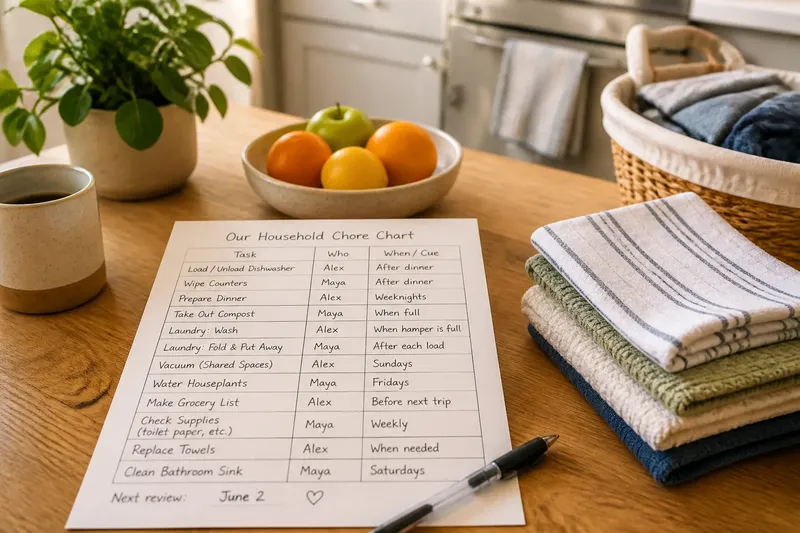
A household chore chart can make shared work easier to discuss before anyone opens a spreadsheet. Start with a sheet of paper, a pen, and a conversation about what actually needs doing; the record is useful because it makes assumptions visible, not because it can issue orders.
In many homes, chores begin as customs rather than assignments: one person notices the recycling, another handles dinner, and someone else quietly replaces the toilet paper. That arrangement may feel effortless until schedules shift, work goes unseen, or a task is assumed to belong to whoever notices it first. A written chart gives the household something specific to examine together.
What should the chart make visible?
Keep the chart focused on recurring work, not every small act of cooperation. List tasks that regularly consume time or attention, including the less visible parts that make a room usable: planning meals, checking whether laundry is ready to fold, wiping the stove, or remembering that the dog’s food is running low.
Begin with a short inventory made by the people who live there. Walk through the kitchen, bathroom, entry, and shared living spaces, and note the work that keeps each area functioning. Include tasks that happen daily, weekly, or only when a particular need arises, but describe them in ordinary language.
- Kitchen: load or unload the dishwasher, clear counters, prepare dinner, take out compost.
- Bathroom: replace towels, clean the sink, restock toilet paper.
- Laundry: gather clothes, run a load, fold and put away clean items.
- Shared spaces: vacuum, return stray items, water houseplants.
- Household planning: make a grocery list, check supplies, arrange a needed appointment.
Do not treat the list as a moral inventory. Its purpose is to show the work that exists, including tasks that have become so familiar that nobody mentions them. A chart that includes only visible cleaning can miss the remembering and arranging that precede it.
How do you turn customs into clear tasks?
Write each task so that a person can tell what counts as done. “Kitchen” is too broad to assign fairly; “wipe the counters after dinner” is clearer. “Laundry” might mean sorting and starting a load to one person, while another assumes it includes folding and putting clothes away. Separate those parts if the distinction matters in your home.
Then ask who currently does each task and how the arrangement came about. Avoid treating the answer as a permanent claim of ownership. A person may handle a task because their hours once made it convenient, because they noticed it first, or because nobody ever proposed another arrangement.
Say you share an apartment and one person usually cooks while the other washes dishes. A new evening class changes the cook’s schedule, so you write down dinner preparation, dishwashing, and grocery planning separately; the expected result is a clearer discussion about which duties can move to another day or person, rather than an argument over who “always” handles the kitchen.
How should household chores be divided?
Use the inventory to discuss capacity, preferences, and practical constraints before assigning names. Available time matters, but so do energy, access to equipment, work shifts, caregiving, and whether a task is unpleasant or difficult for someone. Equal division does not always mean identical tasks or the same number of boxes on paper.
Ask each person which chores they would rather take, which they strongly dislike, and which they cannot reasonably do. Then look for an arrangement that feels workable across the whole list. If one person handles a larger share of cooking, for example, another might take on a different recurring task, rather than adding an unspoken expectation that the cook also manages every related detail.
Be precise about shared tasks. “Everyone cleans up” can mean that everyone participates, or that one person eventually clears the room after waiting. A chart can name who takes the lead on a task and what help, if any, is expected from others. It should not turn ordinary family cooperation into a courtroom exhibit.
When should each task happen?
Choose timing that fits the household’s actual rhythm. A chore chart does not need to assign every task to a weekday. “After dinner,” “before the next grocery trip,” or “when the hamper is full” may be more useful than a rigid calendar slot, provided everyone understands the cue.
For tasks that depend on one another, write down the handoff. If clean dishes need to be put away before another load can be started, name the sequence or decide who handles each part. For occasional work, such as changing sheets in a guest room, list a trigger instead of making it appear due every week.
Keep the first version modest. Include the recurring tasks that cause confusion or resentment, then leave low-friction habits informal if everyone agrees. A chart crowded with every small courtesy can become harder to use than the household routine it was meant to clarify.
Where should the household chore chart live?
Put the record where the people who need it can see and update it. A paper sheet on the refrigerator or inside a kitchen cabinet may suit a household that already gathers there. A shared note in Google Keep or Apple Notes can work if everyone checks it and has access.
Choose the least complicated format that supports the conversation. A table with task, person, and timing is often enough. Use a recurring calendar reminder only when the household needs one; adding alerts for every task can make the chart feel like a manager with a very small office.
Make the record legible and easy to revise. Use a pencil, erasable marker, or an editable shared note, and include a simple date for the next review. The record should reflect current agreements, not preserve an old arrangement because nobody wants to rewrite it.
What questions come up when making a chore chart?
Should a chore chart include children?
It can include age-appropriate household contributions, described plainly and reviewed with the children involved. Keep expectations suited to their abilities and routines, and treat the chart as a way to clarify participation rather than a substitute for adult responsibility.
What if one person does not notice the same mess?
Define the task and its cue instead of relying on someone to notice it at the right moment. “Clear the dining table after dinner” is easier to discuss than “keep the dining room tidy,” which leaves both the standard and the timing open to interpretation.
How often should the chart be revised?
Review it when schedules, household membership, or needs change, and occasionally when the current arrangement is no longer working. A brief conversation is enough to decide whether tasks should move, be divided differently, or disappear from the list.
What if a task is missed?
First distinguish an isolated miss from a recurring problem. Ask whether the task was unclear, badly timed, or simply forgotten; then adjust the wording, cue, or assignment if that would help. The point is to make work discussable, not to create a record of every lapse.
How do you keep the chart from becoming a scorecard?
Use neutral wording and discuss the arrangement as a shared household tool. Avoid marks that imply praise, blame, or a debt to be repaid unless the people involved have deliberately chosen that system. A chore chart is most helpful when it reveals a mismatch between expectations and available time before that mismatch hardens into a grievance.
When reviewing it, ask what has become easier to remember and what remains awkward. A task may be missing, too broad, assigned at the wrong time, or no longer necessary. Remove work that no longer applies; the chart does not need to preserve chores for historical reasons.
The household chore chart works best as a visible draft of an agreement, not a permanent constitution for the kitchen. Keep it where the household can use it, revise it when life changes, and let the written record do one useful thing: give people a shared starting point for talking about work that used to happen mostly by assumption.