Open Baskets or Lidded Boxes for Everyday Storage?
Open baskets or lidded boxes for everyday storage: match visibility, access, and visual quiet to what you keep, so useful things stay easy to retrieve.
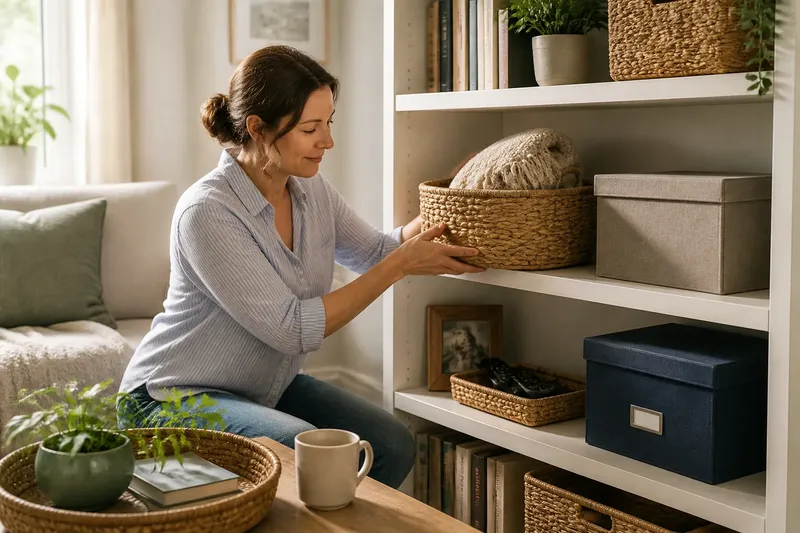
Open baskets or lidded boxes for everyday storage is a choice about how often you want to see and reach an object. A basket makes its contents visible and quick to grab; a box puts a quiet surface between those contents and the room. The useful option depends less on the container’s appearance than on what goes inside and how often you use it.
That distinction matters in a living room, bedroom, or hallway, where storage is also part of what you see. A container can make a room feel calmer while making its contents harder to remember. Or it can keep an item close at hand while displaying a small, unplanned collection of things.
What does each container make easier?
An open basket reduces the number of actions between noticing an item and picking it up. You can see the contents, reach in without lifting a lid, and return something with little ceremony. This suits objects used repeatedly through the day, such as a current knitting project, a few television remotes, or the throws used in one sitting area.
A lidded box adds a pause: lift the lid, find the item, then close it again. In exchange, the lid conceals the contents and provides a more visually settled surface. A box is often a better fit for things that are useful but do not need to announce themselves between uses, such as spare charging cables or stationery kept in a guest room.
Neither container makes a room tidy by itself. A basket can become a visible holding pen, and a box can become a place where miscellaneous belongings vanish from sight. The container helps only when its contents have a sensible purpose and the act of putting them away is easy enough to repeat.
How often will you reach for what is inside?
Think in terms of use, not just category. “Cords” is a category; “the cord used each evening to charge a reading light” describes a routine. The second detail says more about whether a lidded container will feel convenient or tiresome.
For items used several times in an ordinary week, an open basket can reduce friction. Put it where the activity happens, rather than where an empty corner happens to be. A small basket beside a reading chair can hold the current book and reading glasses; a large catchall across the room is more likely to collect whatever was nearest.
For items used occasionally, the lid’s extra action may be negligible. Gift wrap, spare notebooks, or the parts for a hobby you pick up now and then can sit in a lidded box on a shelf. If the contents are needed in a hurry, however, a label or a clear box can preserve some visibility without leaving everything on display.
Use also changes over time. A basket for a project in progress may work well while the project is active, then become an awkward display once it is put aside. Moving the finished project into a lidded box, or returning it to a closet, is not a failure of the basket. It is a change in the storage job.
When is visibility useful, and when is it noisy?
Visibility helps when seeing an object reminds you to use it. A basket of current mail, for example, may keep papers from disappearing into a drawer. But if the basket receives old envelopes, receipts, and unrelated notes, the visible reminder becomes a visible backlog.
Choose an open container for a small, recognizable group of belongings. Repeated shapes and a limited mix of items are easier to read than a jumble of small objects. A shallow woven basket for a few frequently used cloth napkins is easy to scan; a deep basket filled with mixed household odds and ends is not.
A lid is useful when visual quiet matters more than immediate recognition. On a bedroom shelf, a box can hide spare linens or personal accessories that would otherwise form a busy patch in the room. It also makes it easier to keep a consistent surface, though it cannot make an overfilled box easier to use.
Consider the room’s sightlines. A container on an open shelf is part of the room’s appearance whether it is woven, fabric-covered, metal, or cardboard. A box with a lid may soften the view, while a basket can add texture; either can look cluttered if it holds unrelated items or sits in a place where people constantly brush against it.
Which shape and material suit the contents?
Start with the object, then choose the container. Soft throws and scarves can fold into flexible baskets, while papers, small tools, and objects with parts are easier to sort in a box with a stable base. A rigid-sided container is also less likely to slump when stacked or placed on a shelf.
Check whether the contents need air, protection from dust, or a clear view. Woven baskets leave gaps; fabric bins may be lighter but less rigid; plastic boxes can reveal their contents while keeping dust off. A solid lid offers visual concealment, but it is not a substitute for the storage conditions an item requires.
Access includes the container’s opening, not just the presence of a lid. A narrow basket can make it difficult to reach the bottom, and a box on a high shelf may be awkward to open while supporting it. Choose a size and shape that let you remove the contents without tipping everything onto the floor.
Think about what happens when the container is full. Baskets invite a quick drop-in, which can lead to items piled above the rim. Boxes can appear orderly while becoming difficult to close. Leave enough room for the intended contents to go in and come out without rearranging the entire collection each time.
How do you choose between open baskets and lidded boxes?
Are open baskets better for daily-use items?
They can be, when the contents are a small group you reach for often and can recognize at a glance. Choose a basket with an opening wide enough for the actual objects, and place it near the activity. If it becomes a mixed pile, reduce its contents or give separate items another home.
Do lidded boxes make a room look less cluttered?
A lid hides the contents from view, which can make a shelf or corner look quieter. It does not solve disorganization inside the box, so keep the contents related and identifiable. A simple label can help when the box is opaque.
Should I use a clear box or an opaque one?
A clear box keeps the contents visible while protecting them from dust, making it useful when recognition matters more than a uniform appearance. An opaque box creates a calmer view but benefits from a label. The choice turns on where the box sits and whether you need to identify its contents without opening it.
Can I change a basket to a box later?
Yes. If an item is used less often, moved to a different room, or no longer needs to stay visible, its storage can change with it. Say you keep a current sewing project in an open basket beside the sofa, then put it aside for another activity; moving its fabric and tools into a labeled box on a closet shelf would make the sitting area quieter while preserving a clear place to find the project later.
What small trial can settle the choice?
Before buying a set of matching containers, use one basket or box you already own for the specific belongings in question. Keep the contents together in the place you expect to store them, and notice what feels inconvenient: searching, lifting a lid, seeing the contents, or putting everything back. That observation points to the feature that matters.
For a more direct comparison, temporarily divide similar items between an open basket and a lidded box. Use one for objects you reach for often and the other for items used less frequently, then notice whether either arrangement causes extra handling or turns into a catchall. This is a household trial, not a verdict on all baskets or boxes; the result applies to that set of belongings and that room.
Keep the routine simple enough that someone else in the household can follow it without asking where an item belongs. A container should make the expected action clear: place the current items here, return them after use, and leave unrelated objects elsewhere. If the contents keep crossing categories, the problem may be the container’s assigned job rather than its material.
Where does the choice leave you?
For everyday storage, an open basket is usually the more direct choice when visibility and quick access help an object stay in use. A lidded box is often more comfortable when visual quiet, dust protection, or less frequent access matters more. The distinction is practical, not a rule that every room must obey.
Choose for the actual contents, the location, and the ordinary path from putting something away to taking it out again. If a basket keeps useful belongings visible without becoming a pile, let it do that job. If a lidded box makes seldom-used things easier to live alongside, use the lid—and mark the box if its calm appearance would otherwise make its contents a mystery.